Parquet massif, contrecollé ou stratifié : comment choisir pour chaque pièce ?
Vous voulez du parquet. Mais face aux étiquettes en magasin, les doutes arrivent vite.
Massif, contrecollé, stratifié… Ces trois mots ne désignent pas le même produit. Ils n'ont pas la même composition, la même durée de vie, ni le même budget.
Et surtout, ils ne conviennent pas aux mêmes pièces.
Ce guide vous donne les clés pour choisir le bon parquet, au bon endroit, pour le bon usage.
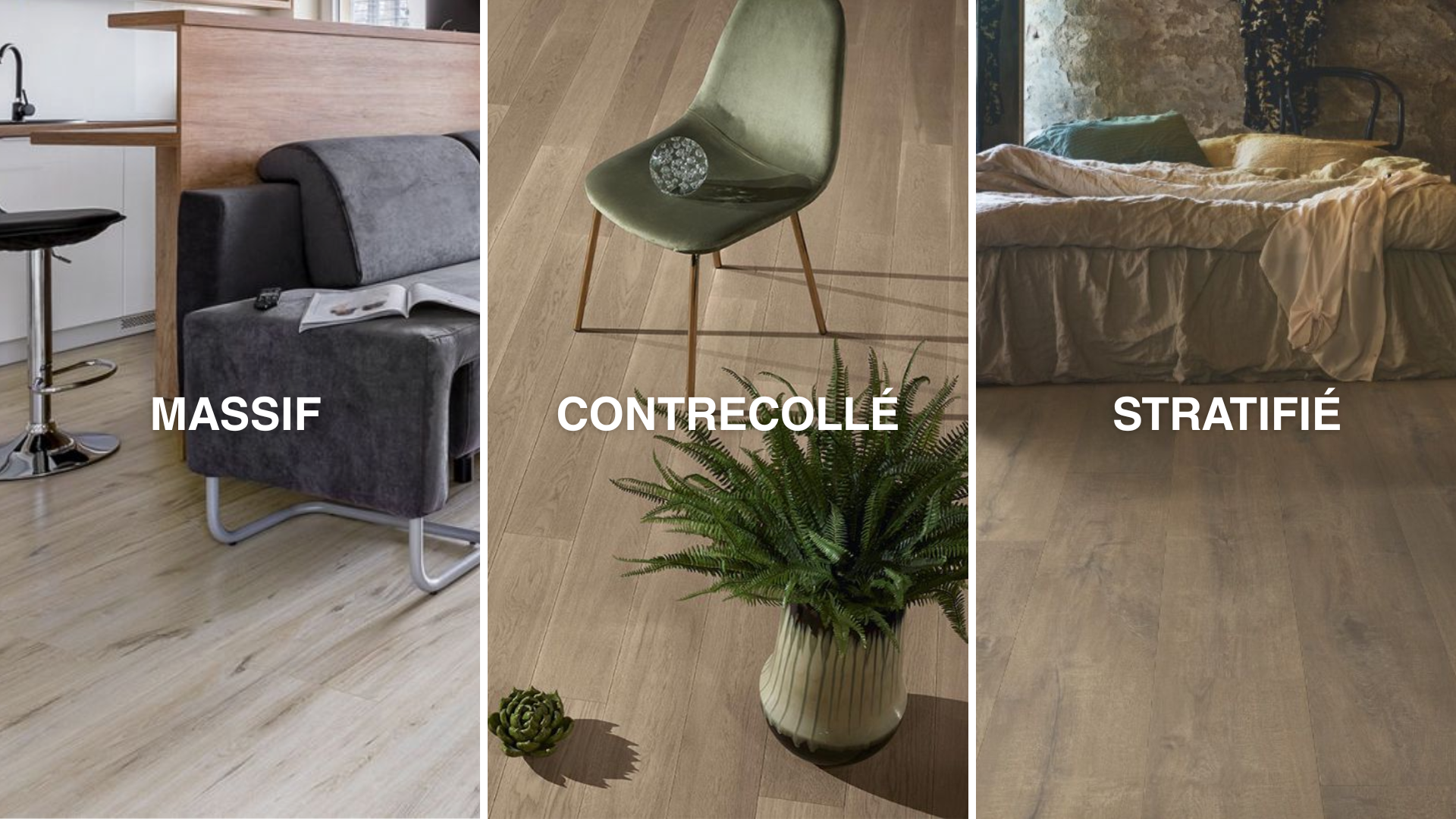
D'abord, une précision importante...
Le terme "parquet stratifié" est techniquement incorrect.
Un parquet, selon la norme française, doit comporter au moins 2,5 mm de bois noble en couche d'usure. Or le stratifié n'en contient aucune. C'est une imitation bois, très convaincante visuellement, mais composée de résine et de panneaux HDF.
En résumé :
- Parquet massif - 100 % bois noble, une seule essence, de haut en bas de la lame
- Parquet contrecollé - 3 couches, dont une couche supérieure en bois noble (2,5 à 6 mm)
- Sol stratifié - aucun bois noble, imitation bois en résine et panneau HDF
Cela change tout sur la durée de vie, la rénovation possible, et la valeur ajoutée à votre bien.
Le parquet massif : l'investissement sur le long terme
Ce que c'est
Chaque lame est taillée dans une seule pièce de bois noble — chêne, noyer, hêtre, teck, merbau…
C'est le produit le plus authentique du marché. Et de loin le plus durable.
Ses atouts
- Durée de vie : 35 à 50 ans minimum à condition d'un entretien adapté
- Peut être poncé et rénové plusieurs fois : un ponçage tous les 10 à 15 ans suffit à lui redonner un aspect neuf
- Apporte une vraie valeur patrimoniale au logement
- Disponible dans une grande variété d'essences, de finitions (huilé, vitrifié, ciré) et de poses (cloué, collé)
Ses limites
- Sensible aux variations d'humidité et de température : il se dilate et se contracte
- Nécessite une pose professionnelle clouée sur lambourdes ou collée sur chape
- Budget plus élevé à l'achat
Dans quelles pièces ?
- Salon, salle à manger, couloir, bureau: les pièces sèches à fort usage où la qualité se voit et dure
- Chambre: pour une atmosphère chaleureuse et authentique
- Escaliers: sous réserve de choisir une essence suffisamment dure
Le parquet contrecollé : le meilleur rapport qualité/durabilité
Ce que c'est
Le contrecollé est composé de trois couches :
- Le parement (couche d'usure) : bois noble de 2,5 à 6 mm
- L'âme centrale : bois d'essences courantes
- Le contreparement : couche stabilisatrice en bois résineux
Ce système multicouche est précisément conçu pour contrebalancer la dilatation naturelle du bois, ce que le massif ne fait pas.
Ses atouts
- Plus stable que le massif face aux variations de température et d'humidité
- Peut être poncé entre 1 et 5 fois selon l'épaisseur de sa couche d'usure
- Compatible plancher chauffant (pose collée)
- Pose possible en flottant, collé ou cloué, plus accessible que le massif
- Large choix d'essences, de largeurs et de finitions
Ses limites
- Durée de vie inférieure au massif sur très long terme
- La couche d'usure, une fois épuisée, ne peut plus être rénovée
Dans quelles pièces ?
- Toutes les pièces sèches: salon, chambre, bureau, couloir
- Cuisine: bonne résistance si la couche d'usure est épaisse et la finition adaptée
- Sur plancher chauffant: c'est même le choix recommandé dans ce cas
Le conseil Cerazur : Pour une rénovation complète, le contrecollé est souvent le choix le plus pertinent. Il combine la beauté du vrai bois, une bonne résistance et une pose plus flexible, sans le budget du massif.
Le sol stratifié : l'option accessible et pratique
Ce que c'est
Ce n'est pas du bois, mais il peut y ressembler trait pour trait.
Le stratifié est composé d'un panneau HDF recouvert d'un décor imprimé (papier haute résolution imitant le bois) et d'une couche de résine protectrice. Le résultat visuel peut être très convaincant.
Ses atouts
- Prix très accessible: l'option la plus économique par m²
- Facile à poser: pose flottante clipsable, y compris par un non-professionnel
- Entretien simple: résistant aux taches et aux rayures selon la qualité
- Décliné dans une infinité de styles et de teintes
Ses limites
- Impossible à poncer ou rénover. En cas d'usure, il faut tout remplacer
- Sensible à l'eau stagnante selon la qualité du produit
- N'apporte pas de valeur patrimoniale au bien
- Durée de vie limitée en cas d'usage intensif
Dans quelles pièces ?
- Chambre d'amis, bureau secondaire: pièces peu fréquentées où l'esthétique prime sur la longévité
- Logement locatif: budget maîtrisé, remplacement facilité
- Cuisine: possible avec des versions spécialement traitées
Le comparatif en un coup d'œil
|
Critère |
Massif |
Contrecollé |
Stratifié |
|
Composition |
100 % bois noble |
3 couches, bois noble en surface |
Résine + décor imprimé |
|
Durée de vie |
35-50 ans+ |
25-40 ans |
10–20 ans |
|
Rénovation |
Oui, 5-8 fois |
Oui, 1-5 fois |
Non |
|
Stabilité |
Moyenne |
Élevée |
Élevée |
|
Plancher chauffant |
Selon essence |
Recommandé |
Selon produit |
|
Prix indicatif (fourniture) |
€€€ |
€€ |
€ |
|
Valeur patrimoniale |
Forte |
Bonne |
Faible |
Quelle essence choisir ?
L'essence du bois est aussi importante que le type de parquet.
Le chêne est l'essence la plus polyvalente - dure, esthétique, disponible dans toutes les finitions. C'est le grand classique du marché français.
Les essences exotiques (teck, merbau) sont particulièrement résistantes à l'humidité, idéales pour la cuisine ou certains espaces extérieurs couverts.
Le noyer et le hêtre apportent une touche plus contemporaine, avec des teintes chaudes et des veines plus marquées.
La dureté d'une essence se mesure sur l'échelle de Brinell: plus le score est élevé, plus le bois résiste à l'usure quotidienne. C'est un critère à ne pas négliger dans les pièces à fort passage.
Et pour les pièces humides dans le Sud ?
En PACA, le climat méditerranéen joue un rôle dans votre choix.
L'été, les températures élevées et la sécheresse font rétrécir le bois. L'hiver et les épisodes humides le font gonfler. Ces cycles sont plus marqués que dans d'autres régions françaises.
Conséquence directe : le parquet massif demande une acclimatation soigneuse avant pose, et un entretien plus régulier. Le contrecollé, grâce à sa structure multicouche, absorbe mieux ces variations et c'est un avantage concret dans nos intérieurs du Sud.
Prêt à choisir votre parquet ?
Le bon parquet dépend de votre pièce, de votre mode de vie et de votre projet dans le temps.
Chez Cerazur, nos conseillers vous aident à faire le choix le plus adapté, avec des collections de parquets massifs et contrecollés sélectionnés pour leur qualité et leur tenue dans le temps.
Venez découvrir nos collections en showroom à Nice. Touchez les matières, comparez les finitions et repartez avec des réponses claires pour votre projet.
→ Contactez-nous pour préparer votre visite
Découvrez également notre gamme de carrelages intérieurs, dont nos carrelages imitation bois, une alternative durable et sans contrainte d'entretien pour les pièces humides.