Pierre naturelle pour votre villa sur la Côte d'Azur : travertin, marbre ou calcaire ?
Vous rénovez une villa sur la Côte d'Azur et vous hésitez entre travertin, marbre et calcaire ?
Ces trois pierres sont belles. Toutes les trois ont du caractère. Mais elles ne se posent pas au même endroit, ne s'entretiennent pas de la même façon, et ne donnent pas le même résultat selon votre projet.
Voici ce que vous devez savoir avant de choisir.
Ce que ces trois pierres ont en commun
Travertin, marbre et calcaire appartiennent toutes à la grande famille des pierres calcaires.
Elles partagent deux points essentiels :
- Elles réagissent toutes aux acides. Vinaigre, citron, détartrants, javel : ces produits sont à bannir absolument. Ils attaquent la surface de manière irréversible.
- Elles nécessitent toutes un traitement hydrofuge après la pose. C'est cette étape qui fait toute la différence entre une pierre qui dure et une pierre qui se tache ou s'altère.
C'est la première chose que nous disons à nos clients. Pas pour les décourager — mais parce qu'une pose bien faite avec le bon traitement, c'est une pierre qui tient des décennies sans problème.
Le travertin : la pierre de la Côte d'Azur par excellence
Pourquoi il séduit autant
Le travertin est une pierre calcaire formée dans les sources chaudes.
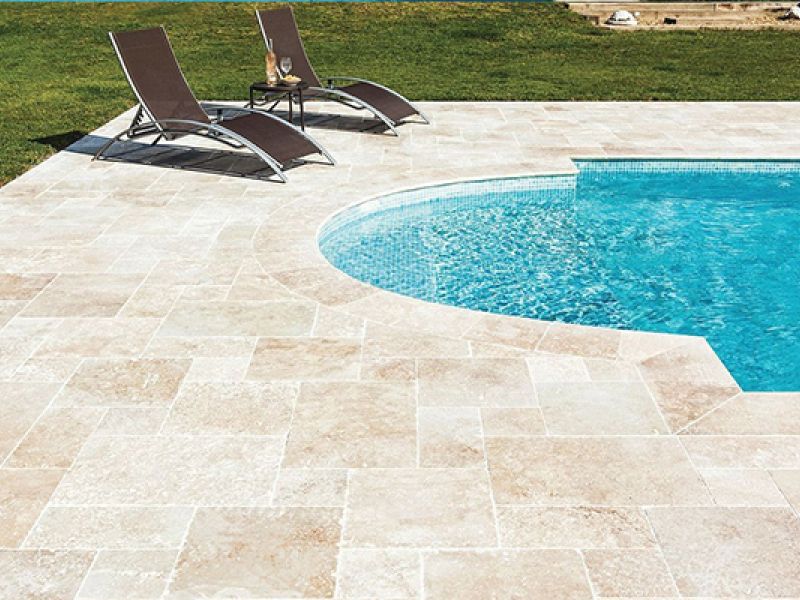
Ses teintes, beige, sable, noisette, parfois gris argenté, s'accordent naturellement avec les architectures méditerranéennes. Chaque dalle est unique. La lumière du soleil en fait ressortir toutes les nuances au fil de la journée.
Et surtout : il reste frais sous le pied en plein été. Contrairement au carrelage classique ou au grès cérame qui emmagasinent la chaleur, le travertin régule naturellement la température. Un vrai avantage autour d'une piscine ou sur une terrasse exposée.
Où le poser
Il est parfaitement adapté à :
- Les terrasses et patios
- Les plages de piscine (finition brossée ou adoucie pour l'antidérapant)
- Les entrées et salons intérieurs
- Les salles de bain
Ce qu'il faut savoir côté technique
Le travertin est poreux. Il se présente naturellement avec de petits trous en surface, c'est sa signature. Ces trous sont rebouchés lors du jointoiement.
Pour l'extérieur, choisissez impérativement une finition brossée ou adoucie, jamais polie (glissant mouillé). Et en bord de mer, une finition adoucie limite l'accroche du sel.
Un traitement hydrofuge s'applique dès la pose, idéalement avant le jointoiement. À renouveler tous les 12 à 24 mois en extérieur, tous les 2 à 3 ans en intérieur.
Pour le nettoyage quotidien : eau claire et savon pH neutre. Jamais de nettoyeur vapeur, jamais de haute pression.
Le marbre : le luxe, mais pour les bons endroits
Ce qu'il apporte
Le marbre est une roche métamorphique. Il s'est formé sous des pressions et températures extrêmes pendant des millions d'années.
Résultat : une densité très élevée, un poli brillant incomparable, et des veinages que rien d'autre n'imite.
Ses couleurs sont larges : blanc de Carrare, beige veiné, gris anthracite, marron chaud (marbre Emperador d'Espagne), noir...
Il apporte une valeur ajoutée réelle à une propriété. Et bien entretenu, il peut durer plus de 100 ans.
Où le poser et où ne pas le poser
Le marbre est le matériau idéal pour :
- Les halls d'entrée et escaliers intérieurs
- Les salles de bain (avec traitement adapté)
- Les plans de travail et vasques (en choisissant des variétés à faible porosité)
- Les revêtements muraux dans les pièces sèches
En revanche, évitez de le poser :
- En extérieur exposé aux intempéries (les pluies acides et les variations thermiques l'érodent)
- Dans une cuisine à fort trafic sans protection sérieuse (il est sensible aux acides alimentaires)
- En étage si la structure n'est pas prévue pour le surpoids (c'est une pierre très lourde)
Ce qu'il faut savoir côté entretien
Le marbre demande plus d'attention que le travertin.
Traitement hydrofuge à renouveler tous les 2 à 3 ans. Nettoyage à l'eau tiède et produit pH neutre. Séchage rapide si votre eau est très calcaire (traces).
En cas de tache acide (vin, agrume, soda) : tamponnez immédiatement sans frotter. Ne laissez jamais stagner de liquide.
Un sol en marbre qui a perdu son éclat peut être repoli. C'est une opération à confier à un professionnel.
Le conseil Cerazur
Le marbre, nous l'avons vu posé dans des centaines de villas sur la Côte d'Azur.
Notre recommandation : réservez-le aux zones intérieures peu exposées aux chocs et aux liquides. Une entrée en marbre de Carrare, un escalier en marbre gris... c'est un choix qui marque l'espace et qui dure.
Pour une salle de bain, choisissez une variété à faible porosité et optez pour une finition adoucie plutôt que brillant miroir — elle pardonne mieux les traces d'eau calcaire.
Le calcaire : la pierre authentique, douce et polyvalente
Ce qu'il apporte
Le calcaire est une roche sédimentaire. C'est lui que l'on retrouve dans les vieilles bâtisses provençales, dans les mas du Luberon, dans les villages perchés de l'arrière-pays.
Ses teintes sont douces : beige clair, ocre, crème, gris pâle. Sa surface, légèrement irrégulière, lui donne un rendu chaleureux très naturel. Il s'accorde aussi bien avec un intérieur contemporain qu'avec une architecture ancienne.
Il accumule la chaleur en journée et la restitue la nuit. En été, il conserve une fraîcheur naturelle agréable.
Où le poser
Il convient très bien pour :
- Les séjours, couloirs et cuisines intérieures
- Les terrasses couvertes ou semi-exposées
- Les murs et crédences (finition parement)
- Les salles de bain avec traitement adapté
Pour l'extérieur pleinement exposé, le choix de la variété est crucial. Certains calcaires sont trop poreux pour résister aux cycles d'humidité. Il faut impérativement vérifier que la pierre est gélivée, c'est-à-dire qu'elle résiste aux alternances eau/séchage, avant toute pose en extérieur.
Ce qu'il faut savoir côté entretien
Le calcaire est plus poreux que le marbre. Le traitement hydrofuge est indispensable dès la pose, et à renouveler régulièrement.
Côté nettoyage : eau et savon noir ou savon pH neutre. Pour l'extérieur, un simple rinçage au tuyau d'arrosage suffit au quotidien. Surtout pas de produit acide, même en faible concentration.
Il se patine avec le temps, développant des teintes légèrement plus dorées ou grisées. Beaucoup de propriétaires apprécient cette évolution naturelle. Elle témoigne du caractère vivant de la pierre.
Le conseil Cerazur
Le calcaire est souvent la pierre que nous conseillons pour créer une continuité entre l'intérieur et une terrasse couverte.
Sa douceur visuelle et sa chaleur au toucher en font un choix très adapté aux grandes pièces de vie qui cherchent un rendu naturel sans l'exigence d'entretien du marbre.
Attention cependant à bien choisir votre fournisseur. La qualité des calcaires varie beaucoup selon l'origine. Chez Cerazur, nous sélectionnons nos pierres directement auprès de fournisseurs italiens, espagnols et portugais, avec un contrôle strict de la qualité avant toute mise en collection.
Tableau récapitulatif
| Travertin | Marbre | Calcaire | |
|---|---|---|---|
| Idéal pour | Terrasse, piscine, salon, salle de bain | Hall, escalier, salle de bain, plan de travail | Séjour, terrasse couverte, mur |
| Extérieur | Oui (finition brossée) | Déconseillé exposé | Selon variété |
| Résistance | Très bonne | Bonne (fragile aux acides) | Moyenne à bonne |
| Entretien | Régulier, accessible | Exigeant | Régulier |
| Hydrofuge | Indispensable | Indispensable | Indispensable |
| Caractère | Chaleureux, méditerranéen | Luxueux, élégant | Naturel, authentique |
| Produits à éviter | Acides, vapeur, haute pression | Acides, javel | Acides, détartrants |
La règle d'or commune aux trois pierres
Quel que soit votre choix : faites poser votre pierre par un professionnel.
La pose de la pierre naturelle n'est pas une pose de carrelage classique. La préparation du support, le choix de la colle, le jointoiement et l'application du traitement hydrofuge sont des étapes techniques qui conditionnent la longévité de votre investissement.
Une pierre naturelle bien posée et bien traitée ne se change pas. Elle vieillit bien, elle prend de la patine, elle gagne en caractère.
C'est justement ce que nos clients cherchent quand ils choisissent la pierre naturelle pour leur villa.
Vous avez un projet de rénovation dans votre villa sur la Côte d'Azur ?
Nos conseillers vous aident à choisir la pierre naturelle adaptée à votre espace, à votre style et à vos contraintes de pose — travertin, marbre, calcaire, ou une combinaison des trois.
Avec plus de 20 ans d'expérience dans les matériaux et la rénovation sur la Côte d'Azur, nous connaissons les spécificités du climat méditerranéen, les contraintes des terrasses exposées au sel, et les attentes des propriétaires de villas dans notre région.
Venez découvrir nos collections en showroom à Nice. Retrouvez nos pierres naturelles intérieures et bien plus encore.