Travertin vs marbre : lequel choisir pour une maison sur la Côte d'Azur ?
Deux pierres naturelles, deux caractères bien différents.
L'un est chaleureux, méditerranéen, et se sent chez lui en extérieur. L'autre est noble, élégant, et transforme n'importe quelle pièce en espace de prestige.
Mais lequel convient le mieux à votre maison et pour quel espace ? Ce guide vous aide à faire le bon choix, pièce par pièce.
Travertin ou marbre : de quoi parle-t-on ?
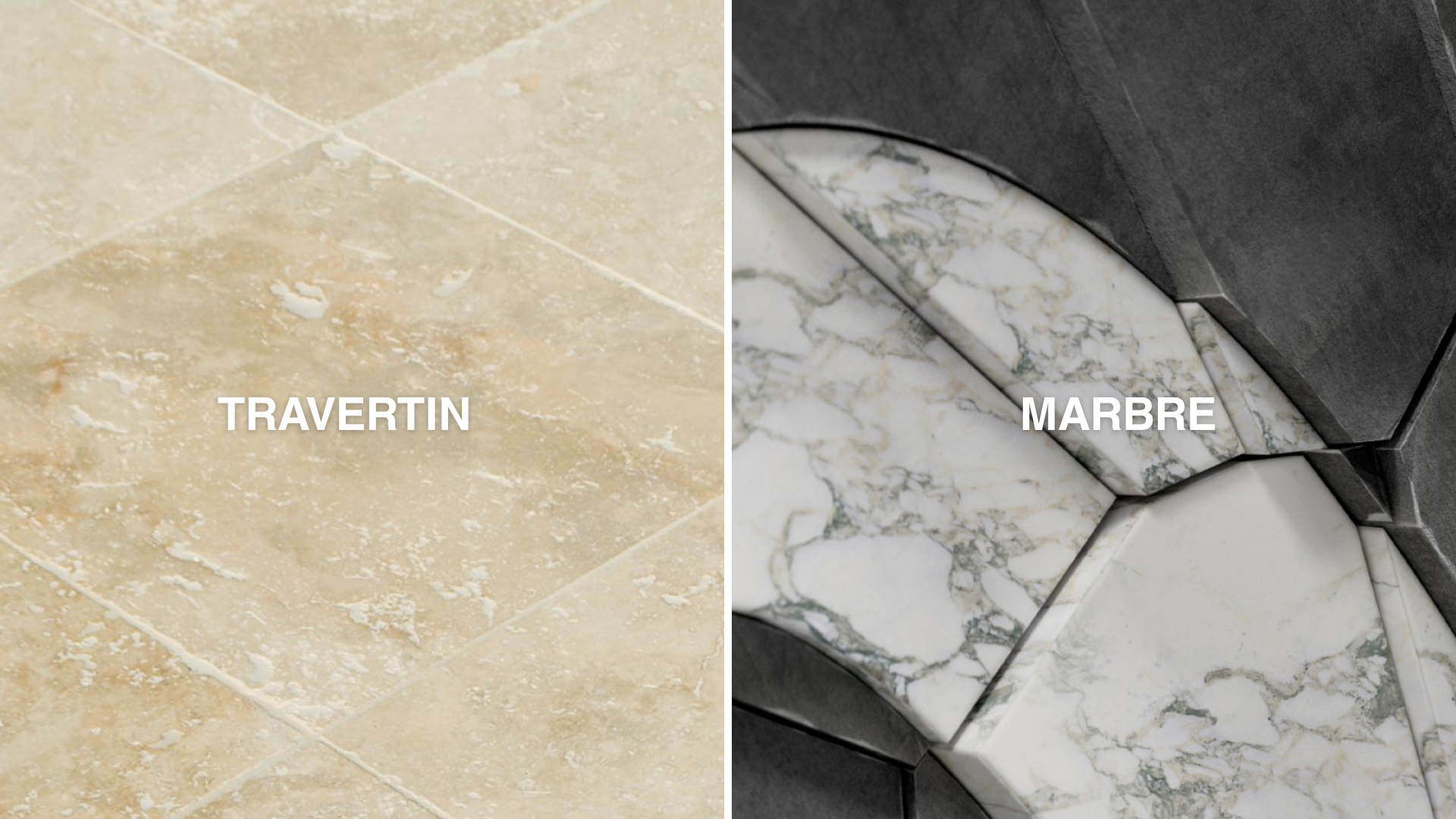
Le travertin n'est pas un type de marbre, même si les deux appartiennent à la famille des pierres calcaires.
Le travertin est une roche sédimentaire formée dans des sources thermales. On le reconnaît à ses tons beiges, crème et doré, et à sa texture légèrement poreuse qui lui donne un aspect authentique et vivant.
Le marbre est une roche métamorphique, née de la transformation du calcaire sous haute pression et haute température. Il se distingue par ses veines élégantes et sa surface lisse et brillante. Il en existe plus de 500 variétés.
Leur formation est différente, et leurs propriétés aussi.
La salle de bain - Marbre recommandé
La salle de bain est sans doute l'espace où le marbre donne le meilleur de lui-même.
Sa surface lisse et brillante crée une atmosphère de spa. Ses veines apportent un caractère unique à chaque projet. Et il est légèrement moins poreux que le travertin, ce qui représente un avantage face aux projections d'eau répétées.
Sur les murs d'une douche à l'italienne ou autour d'une vasque, il apporte une touche de luxe immédiate. Le marbre blanc de Carrare ou le marbre noir veiné sont particulièrement plébiscités sur la Côte d'Azur.
Et le travertin ? Il peut s'utiliser en salle de bain, mais il demande plus de précautions. Sa porosité naturelle nécessite un traitement hydrofuge et oléofuge rigoureux dès la pose. Il convient mieux pour un sol que pour un mur de douche, dans une ambiance déco naturelle et brute.
Notre conseil : Pour une salle de bain, le marbre est le choix le plus adapté. Optez pour une finition polie sur les murs et adoucie sur le sol, car elle est moins glissante. Un traitement hydrofuge est indispensable dès la pose, quel que soit le matériau choisi.
Le salon et les sols intérieurs - Les deux conviennent, selon le style
Pour les sols intérieurs, les deux matériaux sont excellents.
Ils sont durables, résistants à l'usure, et apportent immédiatement de la valeur à la pièce. Le choix dépend avant tout du style recherché.
Le marbre est dans son élément dans les intérieurs contemporains et haut de gamme. Sa brillance capte la lumière méditerranéenne et agrandit visuellement les espaces. Il se marie parfaitement avec le laiton, le verre et le bois foncé. En grand format, il crée une continuité visuelle très élégante.
Le travertin crée une ambiance plus organique, plus chaleureuse. Il est particulièrement adapté aux bastides provençales, aux villas à l'architecture traditionnelle, ou aux intérieurs bohèmes et naturels. Sa pose en opus romain, qui mélange différentes tailles de carreaux de façon irrégulière, lui donne un petit air de ruelle italienne.
Notre conseil : Maison traditionnelle ou bastide ? Choisissez le travertin. Villa contemporaine ou appartement design ? Le marbre sera plus cohérent. Dans les deux cas, évitez les finitions ultra-polies pour un sol, car elles deviennent glissantes. Préférez une finition adoucie ou vieillie.
La cuisine - Marbre recommandé (avec précautions)
Le marbre est très prisé en cuisine, notamment pour les plans de travail. Il reste frais au toucher et sa surface lisse facilite le nettoyage.
Mais attention à sa sensibilité aux acides : c'est le point de vigilance numéro un. Le citron, le vinaigre, le vin et les produits ménagers acides réagissent avec le carbonate de calcium du marbre.
Cela ne signifie pas qu'il faut l'éviter. Cela signifie qu'il faut l'accepter tel qu'il est : une pierre vivante qui demande un peu de rigueur au quotidien.
Le travertin en cuisine fonctionne très bien au sol. Pour les plans de travail, il n'est pas recommandé : ses pores naturels, même rebouchés, peuvent retenir les taches d'huile et de jus.
Notre conseil : Si vous souhaitez du marbre en plan de travail, c'est tout à fait possible. Mais évitez absolument le vinaigre pour nettoyer, essuyez immédiatement toute projection acide, et appliquez un traitement hydrofuge régulièrement. Beaucoup de nos clients apprécient la patine que le marbre développe avec le temps, c'est une beauté qui s'assume.
La terrasse - Travertin fortement recommandé
C'est l'espace où le travertin est vraiment dans son élément. Sur la Côte d'Azur, c'est particulièrement vrai.
Sa résistance aux UV et aux variations de température en fait un matériau idéal pour notre climat. Il résiste au gel, au sel de l'air marin et à l'humidité.
Autre avantage décisif en été : le travertin ne retient pas la chaleur. Contrairement au béton ou à certains carrelages céramiques, il reste agréable sous les pieds nus même en plein soleil de midi. Sa texture naturellement antidérapante est également un argument de sécurité important pour les terrasses exposées à la pluie ou aux embruns.
Et le marbre en terrasse ? Le marbre poli n'est généralement pas recommandé en extérieur : il devient glissant lorsqu'il est mouillé, et il est plus sensible aux variations climatiques. Certains marbres en finition brossée peuvent convenir, mais le travertin reste la solution la plus pérenne.
Notre conseil : Pour une terrasse sur la Côte d'Azur, choisissez du travertin de premier choix, en finition brossée ou vieillie. Prévoyez une épaisseur d'au moins 2 cm. Et appliquez un traitement hydrofuge avant la première utilisation, il protège la pierre du chlore, du sel et des taches.
Les abords de piscine - Travertin, référence absolue
Autour d'une piscine, le travertin s'impose comme une évidence.
C'est le matériau que nous recommandons le plus souvent dans nos projets de villas avec piscine, et ce n'est pas un hasard.
Il est antidérapant naturellement, même mouillé. Il reste frais sous les pieds et sa composition lui permet de restituer la fraîcheur du sol tout en réfléchissant la lumière du soleil. Il résiste à l'eau chlorée, au sel et aux intempéries. Et il vieillit bien : il développe une patine naturelle qui renforce son caractère au fil des années.
Sa palette de teintes, beige clair, ivoire, doré, mix multicolore, s'intègre harmonieusement aux jardins méditerranéens et aux façades en pierre de la région.
Notre conseil : Pour les plages de piscine, privilégiez un travertin de premier choix avec une finition brossée ou antidérapante, en épaisseur de 3 cm minimum. Un traitement hydrofuge renforcé est indispensable face au chlore et au sel. Évitez les travertins de seconde catégorie pour cet usage : la qualité de la pierre fait toute la différence en extérieur.
L'entrée et les couloirs - Travertin recommandé
L'entrée est un espace à fort passage, exposé aux salissures, aux semelles humides et aux chocs.
Le travertin est ici plus adapté que le marbre : moins sensible aux rayures, plus indulgent avec les griffures du quotidien.
Le marbre peut s'y trouver, notamment dans des villas où l'effet "grand hall" est recherché, mais il demandera plus d'entretien et de vigilance.
Notre conseil : Pour une entrée fonctionnelle, le travertin est le choix le plus résistant. Pour un effet de prestige assumé, le marbre fonctionne, mais optez pour une finition adoucie plutôt que polie, qui montre moins les marques.
L'entretien : ce qu'il faut savoir
Les deux matériaux sont des pierres calcaires. Ils partagent donc la même contrainte fondamentale : ils sont sensibles aux acides.
Vinaigre, citron, anticalcaire, javel, tout cela est à bannir absolument, pour le travertin comme pour le marbre.
Pour le travertin :
- Traitement hydrofuge à la pose, à renouveler tous les 2 à 3 ans
- Nettoyage au savon de Marseille ou savon noir dilué
- Produits au pH neutre uniquement
- Entretien extérieur simple à l'eau claire
Pour le marbre :
- Traitement hydrofuge obligatoire, à renouveler tous les 6 à 12 mois
- Produits spéciaux marbre au pH neutre uniquement
- Éponger immédiatement toute projection acide
- Polissage professionnel si la surface devient terne
Vous hésitez encore entre travertin et marbre ?
Le choix entre ces deux matériaux dépend vraiment de votre projet, de votre style et de l'espace concerné.
Nos conseillers vous aident à trancher, avec plus de 20 ans d'expérience dans les matériaux naturels et la rénovation sur la Côte d'Azur. Travertin de premier choix en provenance d'Italie, marbre, finitions adoucies, polies ou vieillies, venez voir et toucher les matériaux en showroom à Nice, c'est souvent là que tout se décide.